
Avoiding Rejections: How We Ensure Phytosanitary Compliance for Agricultural Exports
We don't just ship products—we ship compliance. Here is how every container of Indian rice or dry red chillies meets the strictest global safety norms.
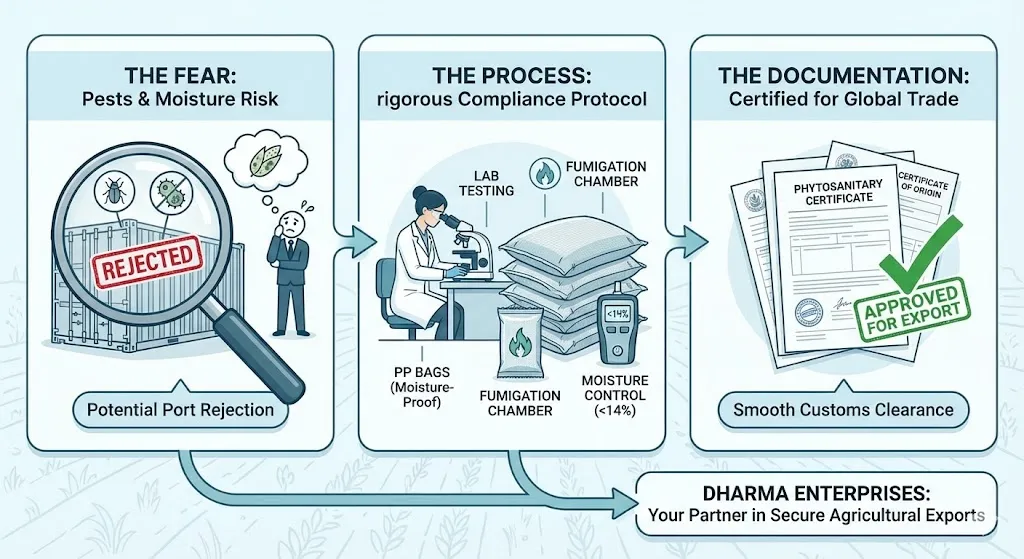
For a new importer, the nightmare scenario is simple: Your container arrives at the destination port, but instead of being cleared, it is flagged by customs. A pest is found, or the moisture levels are too high. The result? The shipment is rejected, leading to devastating demurrage charges, return freight costs, or even incineration of the cargo.
At Dharma Enterprises, we understand that Agricultural Export Standards are not just guidelines—they are the lifeline of your business. We don't just ship products; we ship compliance. Here is how we ensure every container of Indian Rice or Dry Red Chillies meets the strictest global safety norms.
The Fear: Why Do Containers Get Rejected?
The two biggest enemies of agricultural trade are pests and moisture.
Pests: Invasive species like the Khapra beetle can cause immediate rejection in markets like the USA and Europe.
Moisture: If grain moisture exceeds safe limits (>14%), it creates a breeding ground for mold and fungi (such as Aspergillus), which produce harmful mycotoxins.
A single lapse in these areas can cause the "interception and rejection" of produce at export destinations, leading to the withdrawal of export licenses and massive financial loss.
The Process: Our Zero-Tolerance Protocol
To prevent this, Dharma Enterprises employs a rigorous three-step quality control process before the container is even sealed.
1. Scientific Fumigation
Fumigation is mandatory to eliminate pests, but we go beyond a simple spray. We use approved fumigants like Methyl Bromide or Phosphine (Aluminium Phosphide) depending on the destination country's regulations. This process targets all life stages of insects—from eggs to adults—ensuring the cargo remains pest-free during its weeks at sea.
2. Moisture Control (<14%)
Moisture is the silent killer of Indian Rice Quality. We strictly dry and test our rice to ensure moisture content remains between 12% and 14%.
Why 14%? Moisture levels above this threshold increase respiration in the grain, generating heat and trapping dampness that renders fumigation ineffective. By keeping it under 14%, we ensure the grain remains firm and resistant to infestation.
3. Lab Testing for Residues
European and American markets have strict limits on chemical residues (MRLs). We conduct pre-shipment testing to ensure our products are free from banned pesticides (like tricyclazole in the EU) and microbial contaminants.
Packaging: Jute vs. PP Bags
Selecting the right packaging is a critical phytosanitary measure.
Jute Bags: These are traditional and eco-friendly. Their key advantage is "breathability," which allows ventilation and reduces the risk of mold in dry environments. However, they offer poor moisture protection if the external environment is humid.
PP (Polypropylene) Woven Bags: For many clients, we recommend PP bags because they are moisture-proof, insect-proof, and tear-resistant. They provide a superior barrier against external humidity and pests compared to jute.
Documentation: The "Green Channel" Paperwork
The physical quality of the goods is only half the battle; the paperwork must match. We provide a comprehensive documentation suite to ensure smooth customs clearance:
- Phytosanitary Certificate: Issued by the National Plant Protection Organization (NPPO), this document certifies that the shipment has been inspected and is free from regulated pests.
- Certificate of Origin: Confirms the produce is of Indian origin, essential for calculating tariffs.
- Fumigation Certificate: Proof that the cargo was treated according to international standards.
Partner with Confidence
Don't let compliance fears stall your business growth. Partner with an exporter who takes compliance as seriously as you do. Reach out to Dharma Enterprises.
Partner with an exporter who ships compliance.
Reach out to Dharma Enterprises for Indian rice, dry red chillies, and more—with full phytosanitary and documentation support.
Get a quote now