
Why Global Buyers Source Agricultural Products from India: A Data-Backed Analysis
Scale, reliability, compliance, and variety—why international buyers keep turning to India, and what to watch for when you do.
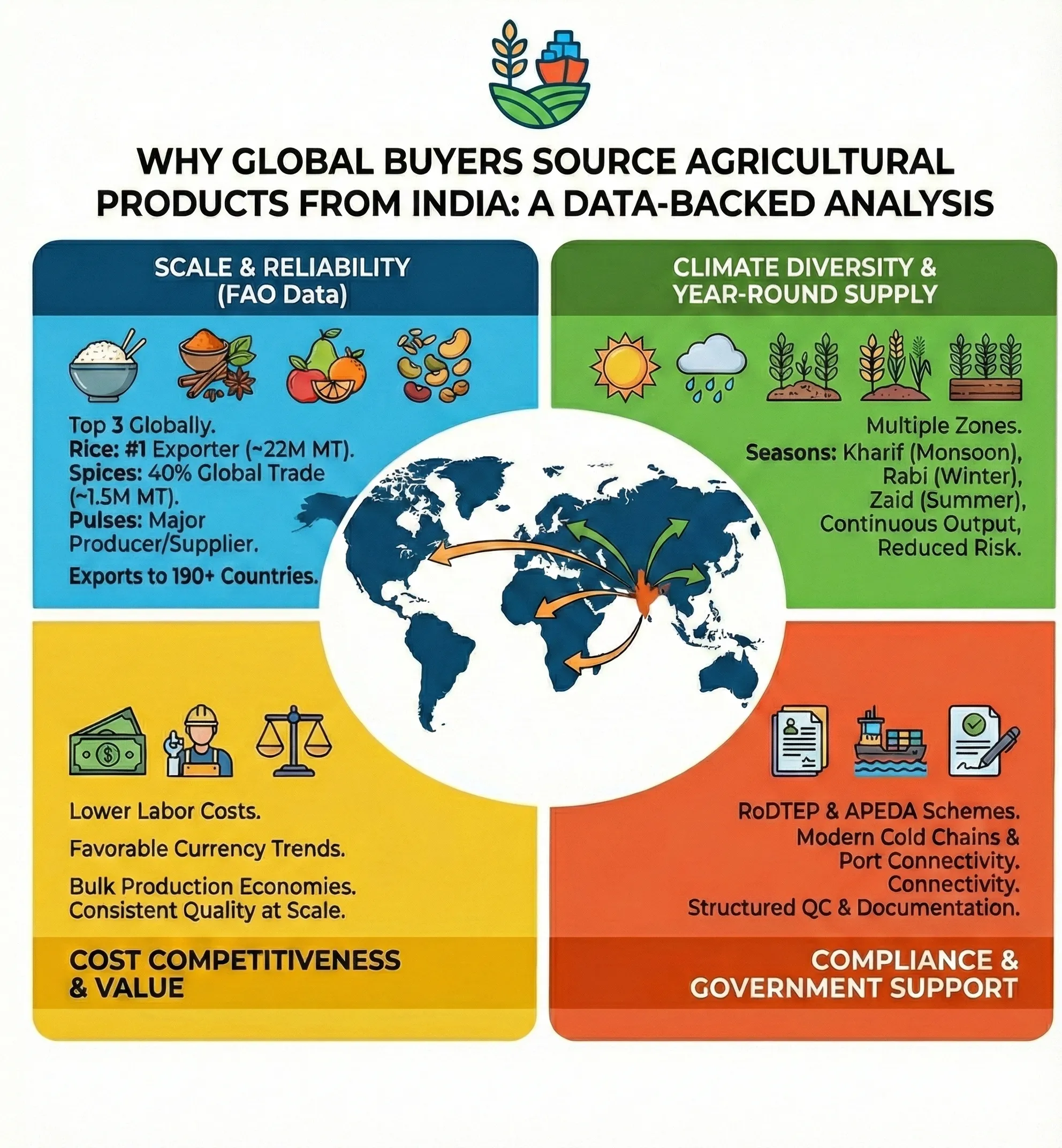
Sourcing agri products isn’t just about finding the cheapest supplier anymore. Buyers care about reliability, scale, compliance, and spreading risk. Over the last twenty years India’s become one of the go-to hubs for exactly that—climate diversity, huge production, government-backed export setup, and cost. Here we look at the numbers and the reasons, and we’ll also cover the risks and how solid exporters handle them.
India’s position in global agricultural trade
FAO data puts India in the top three globally for rice, fruits, vegetables, spices, pulses, and several plantation crops. Exports reach 190+ countries—so the footprint’s real.
Global export leadership
India holds a dominant or near-dominant position in several categories:
- Spices: Around 40% of global spice trade by volume—over 1.5 million metric tonnes a year (Spices Board India).
- Rice: The world’s largest rice exporter for over a decade, roughly 21–22 million tonnes a year (APEDA).
- Pulses: One of the largest producers and a major supplier of chickpeas and pigeon peas to global markets.
- Fresh fruits: Among the largest exporters of mangoes, bananas, and pomegranates, with increasing global market penetration.
Export growth trends
India’s agricultural exports have shown strong growth, crossing USD 50 billion a year in recent years (Ministry of Commerce). That reflects expanding international demand, improved logistics infrastructure, and tighter quality compliance. For buyers, the massive production base translates into supply reliability—which is critical for food processing, retail supply chains, and bulk commodity procurement.
Climate diversity and year-round supply advantage
One of India’s underrated strengths is geography. The country spans tropical, subtropical, arid, and temperate zones—so different crops run at different times across regions.
Multi-crop harvesting zones
India runs multiple cropping seasons:
- Kharif (monsoon): Rice, pulses, spices, fruits.
- Rabi (winter): Wheat, chickpeas, oilseeds.
- Zaid (summer): Fruits, vegetables, short-duration crops.
That segmentation keeps agricultural output continuous through the year.
Seasonal overlap ensures export continuity
For example: rice is harvested in different states at staggered intervals. Spice crops such as turmeric, chillies, and cumin are produced across multiple states with overlapping harvest cycles. Fruit production varies by geography, so export seasons extend. Multi-regional production reduces the risk of supply disruption from localised weather—a key advantage for buyers who depend on steady shipments.
Cost competitiveness without compromising quality
India’s pricing edge isn’t only about low cost—it’s structural.
Labour economics
Agricultural labour costs in India remain lower than in many developed economies and several competing exporters. The ILO and others note that labour-intensive crop production benefits from a large, experienced rural workforce.
Currency advantage
Movements in the Indian rupee often create favourable purchasing conditions for foreign buyers. Depreciation generally improves export competitiveness by reducing dollar-denominated pricing.
Bulk production economies
Large agricultural acreage and high crop volumes let exporters operate at scale. Milling, grading, and packaging at that scale lower per-unit export costs while maintaining consistent quality standards.
Product variety unmatched by other exporting countries
India’s agricultural diversity goes beyond volume into product specialisation.
Region-specific varieties
India offers a wide range of crop varieties from centuries of region-specific cultivation: multiple rice types from aromatic premium to staple non-aromatic grains; diverse chilli varieties by pungency and colour; numerous turmeric cultivars by curcumin content; and region-specific fruits and pulses suited to different culinary markets.
Specialty and heritage produce
There’s also strong global demand for Geographical Indication (GI)-tagged products, organic produce, and traditional and indigenous crop varieties. That variety lets buyers tailor sourcing by market preference, culinary use, and price segment.
Government export support and incentives
India’s agricultural export growth is supported by structured government initiatives.
Export promotion schemes
- RoDTEP (Remission of Duties and Taxes on Exported Products): Refunds embedded taxes on exports, improving competitiveness.
- APEDA support programmes: Facilitate export registration, market intelligence, and quality certification.
- Agricultural Export Policy: Focuses on boosting value-added agricultural exports and improving supply chain efficiency.
Infrastructure and port connectivity
India has invested in dedicated agricultural export zones, integrated cold chain networks, and modern container terminals with expanded port capacity. Major export ports—Mumbai, Chennai, Mundra, Visakhapatnam—provide connectivity across Asia, Europe, Africa, and the Americas.
Risk factors buyers should understand before sourcing from India
Despite its advantages, buyers should be aware of certain risks.
Quality variation risks
India’s fragmented farming structure means crop quality can vary between regions and harvest cycles if proper sourcing and QC protocols aren’t followed.
Documentation complexity
Export documentation may include phytosanitary certificates, quality certifications, origin documentation, and import compliance paperwork. If it’s not managed properly, shipments can be delayed or refused.
Logistics planning challenges
Agricultural exports need careful handling of moisture-sensitive cargo, seasonal shipment congestion, and inland transport from farm clusters to port. So you want a partner who knows the drill.
How professional exporters mitigate these risks
Experienced exporters use structured systems to ensure reliability and consistency.
Quality control protocols
Professional exporters implement multi-stage product inspection, moisture and contamination testing, and laboratory quality verification so that shipments meet buyer specifications and international safety standards.
Pre-shipment inspection
Third-party inspection agencies and in-house QC teams verify product grading, packaging integrity, and compliance with contract specifications. That reduces rejection risk and builds buyer confidence.
Standardised documentation systems
Established exporters use standard documentation workflows to meet destination-country regulations. Digital tracking and ERP-based systems help ensure transparency and traceability across the supply chain.
India as a long-term sourcing partner
India’s agri export story is built on scale, diversity, cost, and infrastructure. Climate spread gives you continuity; government schemes help with competitiveness. But it works best when you work with exporters who know quality, compliance, and logistics. If you’re after dependable supply, a wide product mix, and competitive pricing, India’s still one of the strongest options out there—and as global food demand grows, that’s unlikely to change.
Connect with us
Sourcing agri products from India? Get in touch for specs, compliance, and reliable supply.
Get a quote nowSources: FAO; Spices Board India; APEDA; India Ministry of Commerce; International Labour Organization (ILO).