
Indian Dry Red Chilli Export: Varieties, Global Demand, and Buyer Market Insights
Why India leads in dry red chilli exports—key varieties, top importing countries, and what international buyers look for when sourcing chillies.
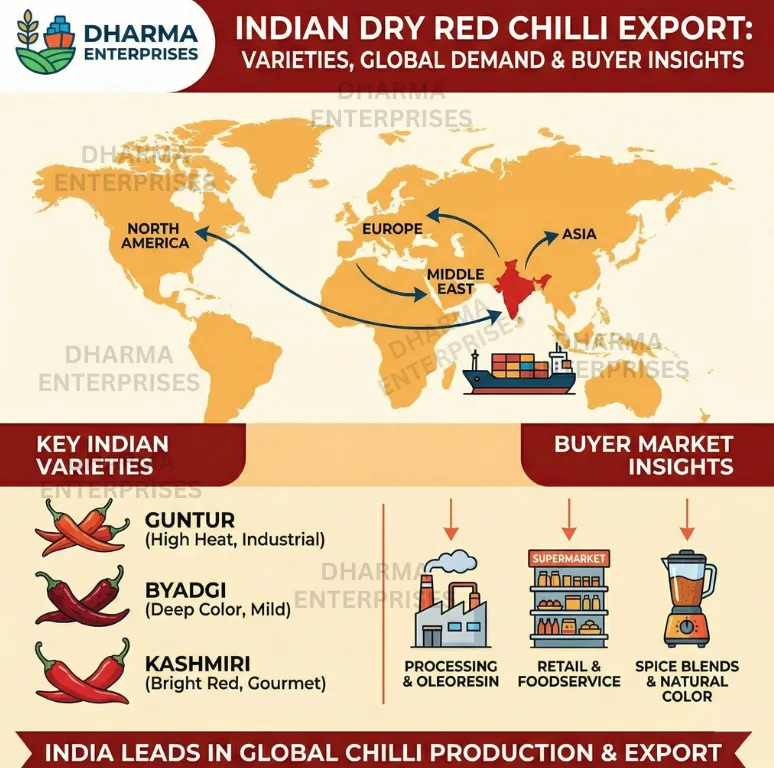
Introduction: India’s position in the global dry red chilli market
India’s the biggest producer, consumer, and exporter of dry red chillies—no contest. Trade data puts the country at over 40% of global chilli production, and the bulk of what gets shipped to Asia, the Middle East, Europe, and North America still comes from here (FAO, 2023, FAOSTAT). So if you’re sourcing at scale, Indian exporters are where most of the world turns.
Dry red chillies show up everywhere: Asian curries, Latin American sauces, European processed foods. Indian supply is steady, the variety is wide, and the pricing’s competitive. That’s why food manufacturers, wholesalers, and spice blenders keep coming back.
Global demand for Indian dry red chillies and key importing countries
Chilli demand keeps climbing—processed food is growing, and more people want natural flavour instead of synthetic. So the market’s in a good place.
Major importing countries
Spices Board India and trade data point to the same set of big buyers. China takes a lot for oleoresin and industrial processing. Thailand and Vietnam use Indian chillies in spice blends and processed foods. The US buys for retail and foodservice. Bangladesh and Sri Lanka are heavy consumers—whole chillies and powder. Malaysia and Indonesia are growing fast as their food processing expands. In 2022–23 India shipped around 0.51 million tonnes of chilli and chilli products and stayed on top globally (Spices Board India, 2023). What’s driving it? Ready-to-eat and processed foods, the spread of spicy cuisines, and the shift to natural colour and flavour. Buyers aren’t just after heat—they want colour, consistency, and traceability too.
Popular Indian dry red chilli varieties and their market preferences
Where India really wins is variety. Different chillies, different heat and colour—so you can match what each buyer’s after.
1. Guntur chilli (Teja / Sannam)
One of the most traded varieties anywhere. Guntur packs serious heat—often 35,000+ Scoville—and a strong, reliable flavour. China, Bangladesh, and much of Southeast Asia buy it for spice powder, oleoresin, and processed food. They like the consistent kick and the fact it’s available in volume (Spices Board India, 2022).
2. Byadgi chilli
Deep red, mild heat. Byadgi’s the one you want when looks matter as much as punch—premium blends, sauces, natural colouring. The US, EU, and Middle East go for it. Food processors who want colour without blowing the palate often choose Byadgi (IISR, 2021, Capsicum Quality Characteristics).
3. Kashmiri chilli
Bright red, low heat. Perfect when the dish needs to look vibrant without burning mouths. Retail in Europe and North America, plus restaurants and hotels, use it in curry powders, marinades, and upmarket packs. The colour and mild heat make it a go-to for gourmet lines (IISR, 2021, Capsicum Pigment and Color Value).
4. 334 and other hybrid varieties
Hybrids like 334 sit in the middle—balanced colour and pungency. They’re flexible: blended powders, mass retail, Southeast Asia and Africa. Good when you need one variety that can do a bit of everything.
Emerging trends in the global dry red chilli market
Three things stand out. First, manufacturers are ditching synthetic colour and flavour—chilli pigments and capsaicin extracts are in demand as clean-label options (Grand View Research, 2023). Second, the spice market’s set to keep growing, and chillies are right in the middle of it because they’re used everywhere (Mordor Intelligence, 2024). Third, buyers want proof: pesticide and aflatoxin compliance, phytosanitary certs, and clear supply chains. Indian exporters who work with regulated chains and government certification are in a good position to deliver that (Spices Board India, 2023, Export Quality Guidelines).
Why international buyers prefer Indian dry red chilli exports
Chillies are grown across Andhra Pradesh, Karnataka, Maharashtra, Telangana, and elsewhere—so you get year-round supply and you’re not stuck on one region (FAO, 2023). Volume and established logistics keep Indian suppliers cost-competitive. And exporters can tailor shipments: heat level, colour value, moisture, packaging. Need heavy-hitting Guntur, colour-focused Byadgi, or kitchen-grade Kashmiri? You can find suppliers who specialise.
Conclusion: Partnering with a trusted Indian dry red chilli exporter
The chilli market’s growing, and India’s production, export volume, and variety make it the default for a lot of international buyers. If you need a steady partner for premium Indian dry red chilli—Guntur, Byadgi, Kashmiri, or hybrids—the right exporter can give you consistent quality, competitive pricing, and scale.
Connect with us
Looking for a reliable partner for Indian dry red chilli? Get in touch for specs, pricing, and a quotation—we'll help you book your shipment.
Get a quote nowSources: FAO (FAOSTAT, global pepper production); Spices Board India (export performance, varieties, quality guidelines); Indian Institute of Spices Research (capsicum quality and colour); Grand View Research (capsaicin market); Mordor Intelligence (spice market forecast).