
Indian Non-Basmati Rice: A Strategic Supply Source for International Buyers
Data-backed insights on global demand, key importing countries, popular varieties, and market trends — with clear source references.
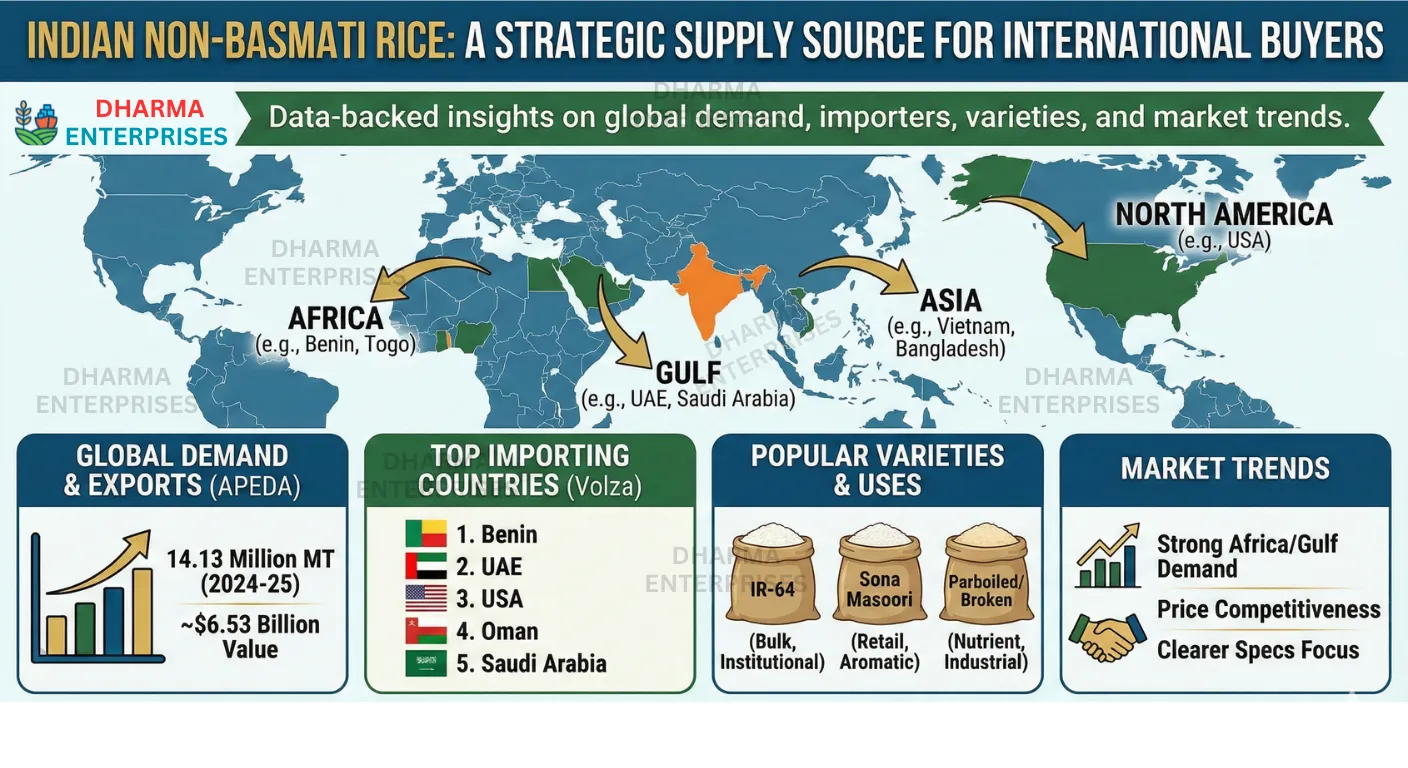
India’s the biggest rice producer and exporter on the planet—and non-basmati makes up a huge chunk of that. If you’re after high-volume, competitively priced staple rice, it’s where most of the action is. APEDA puts the numbers at 14.13 million MT of non-basmati shipped in 2024–25, worth around USD 6.53 billion. A lot of that went to Benin, Guinea, Côte d’Ivoire, Togo, and Bangladesh—so demand’s strong across Africa and Asia.
Below we look at where global demand sits, who’s buying the most, which varieties matter, and what’s moving the market. All figures are from APEDA and Volza so you can use them when you’re planning your sourcing.
Global demand for non-basmati rice
Worldwide, rice exports run past 54 million MT a year—and India’s right at the top. Non-basmati’s the workhorse: everyday meals, institutions, industrial use. It’s cheap enough and available in the kind of volumes that big buyers need. When India relaxed export curbs, non-basmati shipments jumped something like 25% in 2025, and the country’s been winning back share in Africa and Asia. You don’t get that with basmati, which is more of a niche. Non-basmati is what feeds foodservice, retail, and bulk contracts.
Top non-basmati rice importing countries
Volza’s shipment data shows where Indian non-basmati actually lands. The busiest destinations look like this:
| Rank | Importer | Relative activity |
|---|---|---|
| 1 | Benin | ~5,623 shipments |
| 2 | United Arab Emirates | ~3,981 |
| 3 | United States | ~3,655 |
| 4 | Oman | ~2,108 |
| 5 | Saudi Arabia | ~2,089 |
| 6 | Togo | ~1,974 |
| 7 | Vietnam | ~1,955 |
| 8 | Yemen | ~1,720 |
| 9 | Iran | ~1,555 |
| 10 | Kenya | ~1,520 |
Numbers are from 2024–25 cross-border flows.
So you’ve got Africa, the Gulf, the U.S., and bits of Asia all pulling volume—but for different reasons. West Africa wants solid staples for the retail shelf. In the Gulf and the U.S. they care a lot about traceability, certs, and steady supply. Worth keeping in mind when you’re pitching.
Popular Indian non-basmati rice varieties & their uses
There’s a whole range out there—each one fits different markets and uses.
1. IR-64 rice
Medium grain, soft when cooked, pretty neutral. Works for everyday meals, institutional packs, and bulk retail. India ships more IR-64 than anyone; a lot of it ends up in Benin, Togo, and Ivory Coast.
2. Sona Masoori
Lighter, a bit aromatic—the kind people buy for the home kitchen. Grown mainly in South India and exported in bulk as long-grain white. The UAE takes a big share of Sona Masoori.
3. Ponni, Swarna & parboiled rice
Ponni cooks soft and is big in daily diets. Swarna is short-grain and price-conscious. Parboiled holds nutrients better and keeps well—so it’s got a growing place in both industry and household use. Together they cover a wide spread of price points and applications.
4. Broken rice
Cheaper per kilo, so it turns up in animal feed, brewing, and budget retail. Buyers pick varieties depending on grain size, how it cooks, and who’s going to eat it.
Market trends in non-basmati rice trade
Africa’s still taking huge volumes for retail and household use. Same story in the Gulf—UAE, Oman, Saudi Arabia keep buying. After India dropped the export curbs, its rice got price-competitive again next to Thailand and Vietnam, so cost-sensitive buyers have been coming back. On top of that, importers are asking for clearer specs: grain length, broken ratio, moisture, packing. Indian mills can deliver that, and they’re used to FSSAI and phytosanitary paperwork.
Why source non-basmati rice from India?
Scale first: you can place big orders and get them refilled. FOB often works out better than from other origins because of how much India grows and how the policy side is set up. You’ve also got real choice—Sona Masoori for the softer, aromatic side; IR-64 for bulk and institutional; parboiled and broken for specific uses. And the stuff’s already going everywhere, so the logistics and trust are there.
Connect for reliable supply & market-driven varieties
If you want steady volume, clear specs, and a mix of varieties, India’s still the place. Bulk staples, retail packs, foodservice—exporters here can shape the shipment to what your market needs.
Get in touch for current prices, variety specs, and a quotation.
We work with buyers who care about compliance and reliability from origin to port.
Get a quote nowSources: APEDA (Agricultural and Processed Food Export Development Authority); Volza trade shipment data (2024–25).