
IR64 Rice: The "Mega Variety" Powering India's Non-Basmati Exports
Why IR64 is the benchmark for long-grain non-basmati—qualities, markets, and cultivation. For importers and global buyers.
While Basmati often steals the spotlight in the world of premium aromatics, the true workhorse of the global rice trade is IR64. Often hailed as a "mega variety" by agricultural scientists, IR64 has cemented India's status as a dominant force in the international food supply chain.
For importers and global buyers, understanding IR64 is essential—it is the benchmark against which other long-grain non-basmati varieties are often measured. This blog delves into the specific qualities, market dynamics, and cultivation practices that make Indian IR64 a global staple.
The "Gold Standard" of Non-Basmati: Qualities & Specifications
Released originally by the International Rice Research Institute (IRRI) in 1985, IR64 was bred to combine high yield with premium eating quality. In India, it has evolved into a massive trade category, widely appreciated for its versatility.
Why is it preferred? Unlike sticky glutinous rice, IR64 has a high amylose content (approx. 27–29%). This chemical structure ensures that the grains remain firm, fluffy, and separate after cooking, making it perfect for dishes like fried rice, pilaf, and daily table rice where clumping is undesirable.
Key Specifications (Export Standard)
- Grain Length: Long grain, averaging 6.0 mm to 6.2 mm.
- Texture: Soft but firm; non-sticky.
- Forms: Available as Raw White (polished) and Parboiled (Sella/Creamy/Golden). The parboiled variant is particularly prized for its nutritional retention and resistance to breakage during milling.
- Milling Degree: Typically well-milled and Sortex cleaned to remove impurities.
Fact Check: IR64 is widely cited as having "excellent cooking quality" with intermediate gelatinization temperature, which prevents it from becoming mushy. This "fluffiness" is the primary selling point for African and Asian markets. (Source: International Rice Research Institute – IRRI)
Global Export Markets: Who Buys IR64?
India is the world's largest rice exporter, and a significant portion of its non-basmati shipment is IR64. The demand is driven by its competitive pricing and reliable quality.
Top Import Destinations (2024–2025 Trends)
- West Africa (The Parboiled Belt): Countries like Benin, Senegal, Côte d'Ivoire, and Togo are massive importers of Indian parboiled IR64. It serves as a critical food staple due to its durability in storage and affordability.
- Southeast Asia: Nations like Vietnam and Malaysia often import Indian IR64 to supplement domestic supplies during lean seasons or for processing.
- Middle East: While known for Basmati, markets like the UAE and Saudi Arabia import high-quality Sortex-cleaned IR64 for the diverse expatriate workforce who prefer long-grain white rice.
Recent Market Data: According to recent trade data, India's non-basmati rice exports (which include IR64) continue to dominate, with major flows directed toward African nations ensuring food security in the region. In FY 2024–25, Benin alone was a top destination for Indian non-basmati rice. (Source: APEDA & The Dollar Business, Feb 2025)
Cultivation Practices in India
IR64 thrives in India's diverse agro-climatic zones. It is a semi-dwarf variety, which prevents "lodging" (falling over) and allows it to support heavy grain panicles.
Major Growing Regions
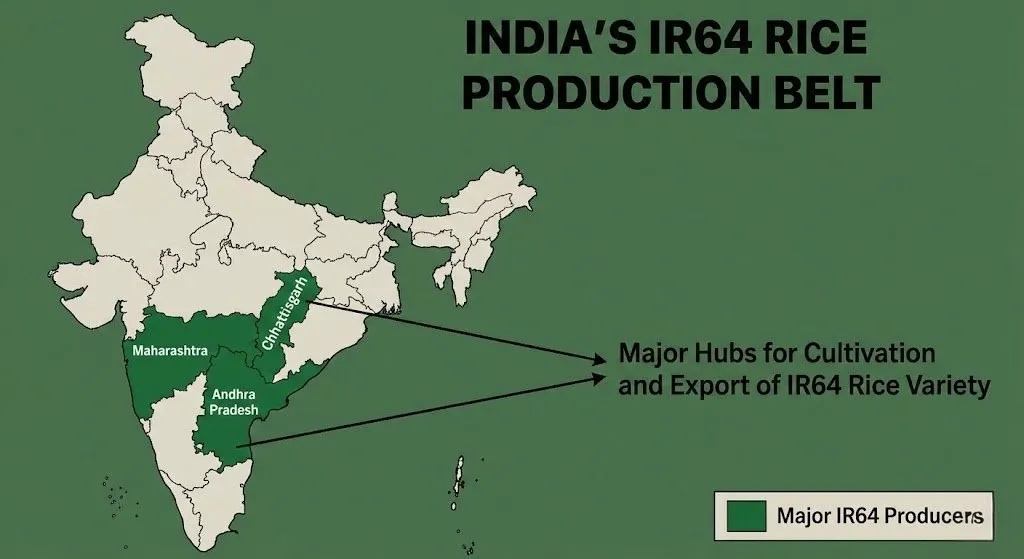
- Andhra Pradesh & Telangana: These states are the heartland of premium IR64 cultivation. The Krishna–Godavari delta provides the ideal irrigation for this water-intensive crop.
- Chhattisgarh: Known as the "Rice Bowl of Central India," this state produces vast quantities of IR64, particularly for the parboiled market.
- Maharashtra & West Bengal: Significant producers contributing to the domestic and export surplus.
Agronomy
- Season: It is grown in both Kharif (monsoon, sown June–July) and Rabi (winter, sown Nov–Dec) seasons in irrigated belts.
- Duration: It is an early-to-medium duration crop, maturing in 115–120 days.
- Yield: It is highly productive, offering yields of roughly 6–7 tonnes per hectare under optimal irrigated conditions.
Challenges and Future Outlook
While IR64 is a powerhouse, it is not without challenges.
- Pest Resistance: Originally bred to resist the Brown Planthopper (BPH), newer biotypes of pests have pushed farmers to use integrated pest management.
- Water Usage: Like most high-yielding varieties, IR64 is water-intensive. However, its early maturity (saving 2–3 weeks of irrigation compared to traditional varieties) makes it relatively water-efficient per kilogram of grain produced.
Despite these challenges, the global appetite for IR64 remains insatiable. Its role is shifting from just a commodity to a branded, quality-assured product for discerning buyers.
Partner with the Best
Sourcing IR64 rice requires a partner who understands the nuances of grain length, moisture content, and milling quality. Whether you need 5% Broken Parboiled for retail in Cotonou or 100% Sortex Raw for a supermarket in Dubai, consistency is key.
DHARMA ENTERPRISES specializes in the export of premium agricultural commodities, ensuring that every shipment of IR64 rice meets stringent global standards. We bridge the gap between India's fertile fields and your local market.
Ready to secure your shipment of premium IR64 Rice?
Contact DHARMA ENTERPRISES today to discuss your specifications and get a competitive quote. Let us fuel your business with the world's favorite rice.
Get a quote nowSources: International Rice Research Institute (IRRI); APEDA; The Dollar Business (Feb 2025).