
Complete Guide to Quality Standards for Exporting Indian Agricultural Produce
What buyers and exporters need to know—certifications, country rules, testing, packaging, and the paperwork that keeps shipments moving.
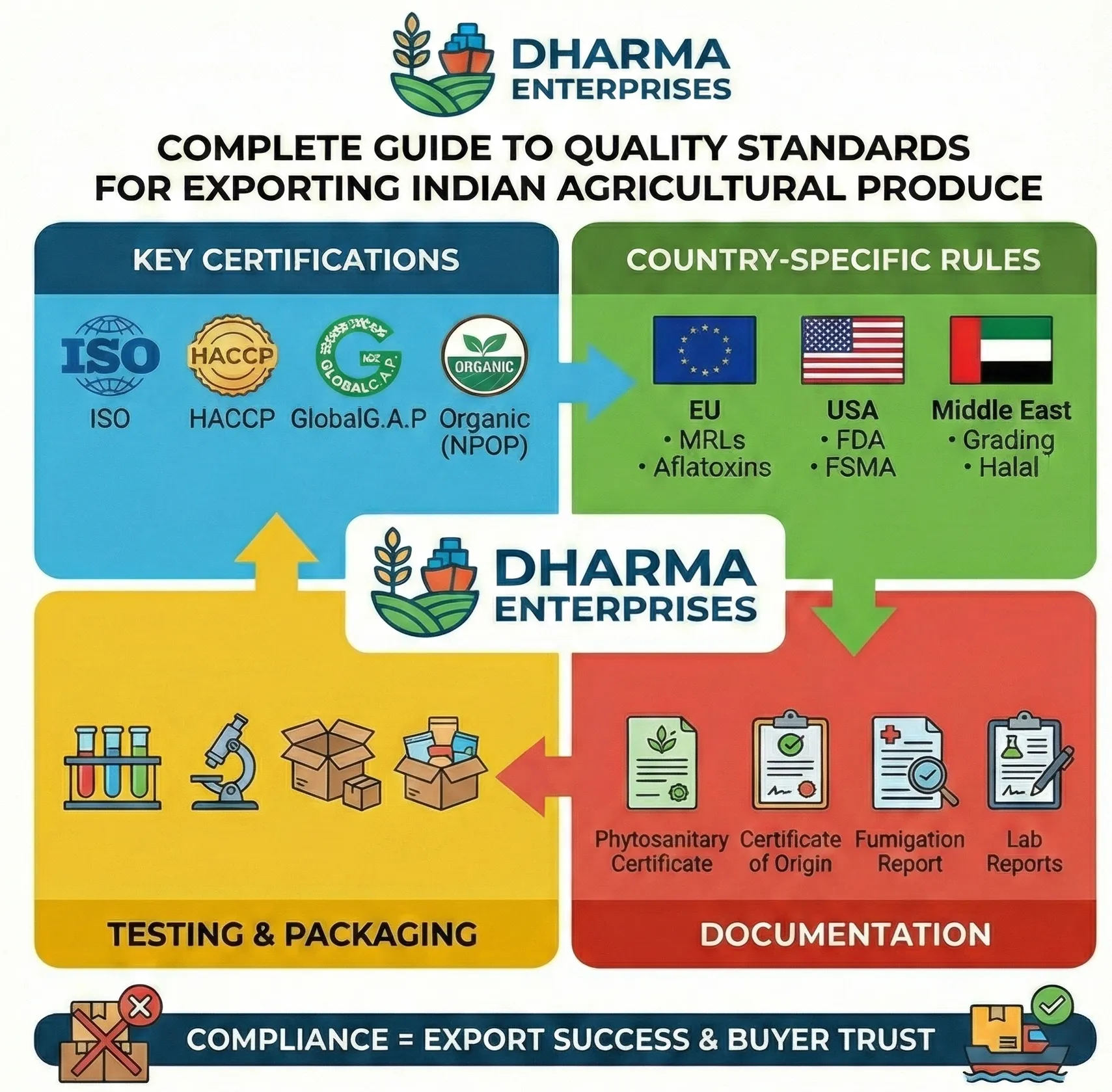
Export rejections hurt—financially and reputationally. When consignments fail at the border because of residue, contamination, or missing paperwork, the cost isn’t just the lost cargo; it’s delays, contract breaches, and sometimes a black mark with the buyer. So quality compliance isn’t a nice-to-have; it’s what decides whether your export succeeds. Buyers expect contracts to be met on spec, and they’ll ask for proof. This guide walks through the standards that matter and the documents you should have in place. References are to current Indian and international frameworks (FSSAI, APEDA, EU, US FDA, Codex) so you can cross-check.
Why quality compliance determines export success
Import rejection statistics and financial impact
EU RASFF (Rapid Alert System for Food and Feed) and US FDA publish refusal and alert data—so you can see how often consignments are rejected and for what reasons. Pesticide residues, aflatoxins, and non-compliant labelling show up repeatedly in that data. The financial impact goes beyond the lost cargo: detention and re-export costs, destroyed consignments, contract penalties, and lost shelf life. Repeated rejections can damage the relationship with the buyer and the reputation of the exporter. So the numbers in those databases aren’t abstract—they’re a direct signal of what happens when compliance is missed.
Buyer contract compliance expectations
Buyers now routinely build contract clauses around maximum residue levels (MRLs), aflatoxin limits, and phytosanitary compliance. They expect specifications to be met and proof to be provided—certificates, lab reports, and the right documentation. If you can’t show you meet those, you’re out of the running. Getting quality and documentation right from the start is what keeps exports—and repeat orders—on track.
Key international certifications buyers expect
Certifications signal that an exporter runs a controlled system. They’re not a substitute for product-specific testing, but they help buyers trust the process.
ISO (e.g. ISO 22000)
ISO 22000 is a food safety management standard that ties in hazard analysis and control. Many buyers ask for it as a baseline for the supply chain. It’s widely recognised and aligns with HACCP principles.
HACCP
HACCP (Hazard Analysis and Critical Control Points) is the backbone of food safety in many markets. US FDA and EU regulations reference HACCP-based controls. Exporters who are HACCP-certified can show they’ve identified critical points and monitor them—which matters for both compliance and buyer audits.
GlobalG.A.P.
GlobalG.A.P. (Good Agricultural Practice) covers farm-level production: inputs, worker safety, environment, traceability. Retailers in Europe and elsewhere often require it for fresh produce and sometimes for other commodities. It’s a clear differentiator when buyers are comparing suppliers.
Organic certification
For organic shipments, destination markets require recognised certification—e.g. NPOP (India’s National Programme for Organic Production) with equivalence to EU or US organic rules, or direct certification against those standards. Buyers will ask for the certificate and often for transaction certificates (TC) per shipment. Without that, you can’t sell as organic in regulated markets.
Country-specific quality requirements
Every market has its own rules. You can’t assume what works for one country works for another.
EU: pesticide residue limits
The EU sets strict maximum residue levels (MRLs) for pesticides in food. They’re listed in the EU MRL database and in Regulation (EC) 396/2005 (as amended). Residues above the limit mean the consignment can be rejected at the border. So you need to know which actives are allowed on your crop and at what level—and test accordingly. The EU also has tight rules on aflatoxins (e.g. Regulation 2023/915). Spices, nuts, and certain grains are high-risk categories.
US: FDA import compliance
US FDA regulates food imports under the Food Safety Modernization Act (FSMA). Importers must ensure suppliers meet US standards; the FDA can refuse entry for adulteration, misbranding, or failure to meet preventive controls. There are specific programmes for certain products (e.g. juice, seafood). Documentation, supplier verification, and sometimes laboratory testing are part of the picture. Staying current with FDA guidance and import alerts helps avoid refusals.
Middle East: quality grading expectations
Gulf and other Middle Eastern buyers often specify grade (e.g. FAQ, FAQ+, or specific grade standards), moisture, purity, and sometimes religious (halal) requirements. Contracts may reference GCC or national standards. So you need to align your grading, testing, and certificates with what the buyer and the destination country expect—and get it in writing.
Laboratory testing and residue monitoring
Testing is how you prove your product meets the numbers. Buyers and authorities expect results from accredited labs.
Microbial testing
Salmonella, E. coli, yeast and mould, and total plate count are common parameters for spices, nuts, and other agri products. EU and US have criteria for certain product types. Testing should be done at a stage that reflects the condition of the product as shipped—and repeated when there’s a change in lot or origin. FSSAI and export bodies like Spices Board India reference sampling and testing protocols.
Chemical residue testing
Pesticide residues must be below the MRL of the destination country. Multi-residue screens are standard; you may need targeted analysis for specific actives. Aflatoxins (B1, total) are critical for nuts, spices, maize, and similar. Heavy metals (e.g. lead, cadmium) can also be required. Labs should be accredited (e.g. NABL in India) and use validated methods. Keeping test reports on file and sharing them with buyers builds trust and speeds clearance.
Moisture and shelf life
Moisture affects stability and mould risk. Many contracts specify a maximum moisture content. Testing at dispatch—and sometimes at receipt—helps avoid disputes. Shelf-life studies or stability data may be needed for labelled best-before dates and for buyer specifications.
Packaging and storage compliance standards
Export packaging has to protect the product and meet food safety and sometimes phytosanitary rules.
Export packaging materials
Jute, paper, and certain plastics are common for agri exports. The right choice depends on the product (e.g. moisture sensitivity, aroma), transport mode, and destination. Re-use of bags or contamination from previous cargo can cause rejections. Wood packaging may need to meet ISPM 15 (heat treatment or fumigation and marking). Storage should be clean, dry, and pest-free; fumigation, when required, must be documented (see Documentation below). APEDA and Spices Board India publish guidance on packaging and storage for export consignments.
Food safety packaging regulations
Materials that touch the product must be suitable for food contact and compliant with the destination market. The EU has strict rules on materials and articles in contact with food (e.g. Regulation (EC) 1935/2004 and related measures). The US FDA regulates food-contact materials too. So packaging isn’t only about strength and logistics—it’s also a compliance point that can trigger rejections if the wrong material is used or migration limits are exceeded.
Documentation buyers should request from exporters
This is the paperwork that keeps shipments moving and satisfies authorities and buyers.
- Phytosanitary certificate (PC): Issued by the national plant protection organisation (in India, the relevant authority under the Ministry of Agriculture). Confirms the consignment meets the importing country’s plant health requirements. Mandatory for many agri and horticultural products. Buyers should request it before shipment and ensure the product and origin match the PC.
- Certificate of Origin (CoO): States where the product was produced or processed. Needed for tariffs, quotas, and trade agreements. Can be preferential (for FTA benefits) or non-preferential. Chambers of commerce or authorised bodies issue them.
- Fumigation report: When fumigation is required (e.g. for pests or as per import conditions), the treatment must be done by a registered operator and documented. The report typically includes product, dosage, date, and standard (e.g. ISPM 15 for wood packaging). Importing countries may ask for this at the port.
- Lab reports: Test certificates for pesticides, aflatoxins, microbiology, moisture, or other parameters as per contract or regulation. Should be from an accredited lab, with clear identification of the lot, sample date, and results. Buyers often keep these for traceability and audits.
Other documents that may be needed include health certificates, quality certificates (e.g. Spices Board quality certificate), and bills of lading or airway bills. Getting the document set agreed in the contract avoids last-minute surprises.
Summary
Quality compliance drives export success: rejections are costly, and buyers expect proof. Certifications (ISO 22000, HACCP, GlobalG.A.P., organic) show you run a controlled system. Country rules—EU MRLs, US FDA, Middle East grading—must be met. Lab testing (microbial, residues, moisture) and proper packaging and storage are part of the same picture. And the right documentation—phytosanitary certificate, CoO, fumigation report, lab reports—is what gets your consignment cleared and keeps your buyer confident. Working with exporters who take this seriously makes a real difference.
Connect with us
Need an exporter who can meet your quality and documentation requirements? Get in touch for specs, test reports, and compliance support.
Get a quote nowSources and further reading: FSSAI (Food Safety and Standards Authority of India); APEDA (Agricultural and Processed Food Products Export Development Authority); Spices Board India (export quality and packaging); EU RASFF, EU MRL database, Regulation (EC) 396/2005, Regulation 2023/915 (aflatoxins); US FDA (FSMA, import alerts); Codex Alimentarius; ISPM 15 (phytosanitary measures); NABL (lab accreditation).