
Teja vs. Sanam: Choosing the Right Dry Red Chilli for Southeast Asian Cuisine
Heat vs. flavour—when to pick Teja (S17) or Sanam (S4) for sambal, curry paste, and hot sauces. A practical guide for importers and processors.
Introduction
In Southeast Asian cuisine, heat isn’t just a sensation—it’s a structural part of the flavour. From the fiery Sambal Oelek of Indonesia to the complex Nam Prik of Thailand and the vibrant curries of Vietnam, the chilli pepper is the heartbeat of the kitchen. But for spice traders, sauce manufacturers, and food processors, sourcing that heat can be a tricky decision.
The global hub for that heat is Guntur, India, often called the “Chilli Capital of the World.” The region’s soil and climate produce chillies with high capsaicin content and strong colour retention, which is why international buyers keep coming back.
What a lot of importers run into, though, is a simple but critical choice: Teja (S17) or Sanam (S4)? Both come from the same rich belt, but they do different jobs in the kitchen. Pick the wrong one and you can end up with a sauce that lacks punch or a curry paste that’s overpoweringly spicy. This guide walks you through the technical and culinary differences so you can make the right call for your market.
Teja (S17) – The king of heat
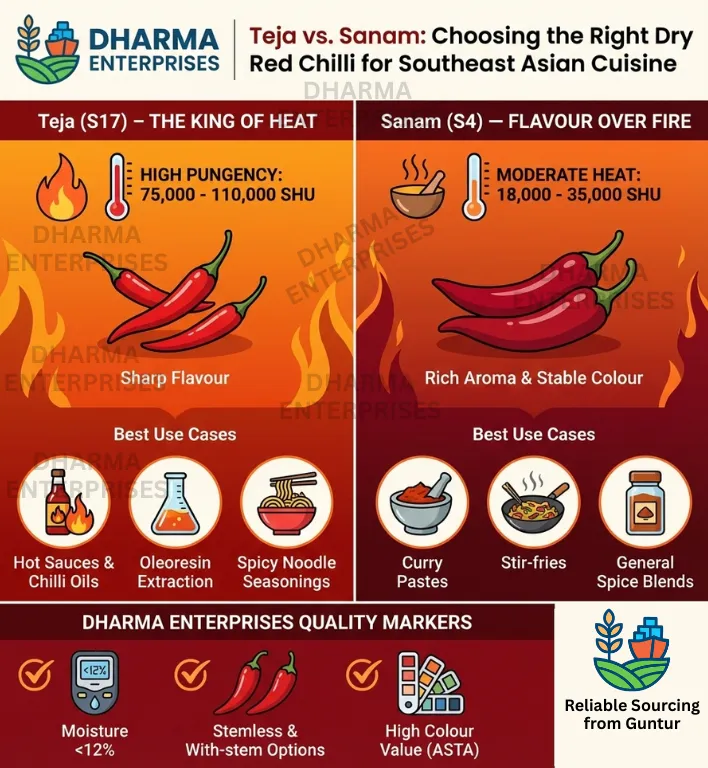
If your end product needs intense, piercing heat, Teja (S17) is the one to go for. It’s one of the hottest commercial chilli varieties you can source from India for export, and its popularity in Southeast Asia is growing fast.
Characteristics
- High pungency: Teja packs a serious punch—typically 75,000 to 110,000 SHU (Scoville Heat Units). That high capsaicin content makes it economical for extraction; you need less product to hit the heat level you want.
- Sharp flavour: Unlike varieties with fruity or smoky undertones, Teja gives you a sharp, biting spice that hits the palate straight away.
- Appearance: The pods are small, sleek, and a fiery bright red.
Best use cases
- Hot sauces and chilli oils: For Sriracha-style sauces or chilli oils where heat is the main selling point, Teja delivers the intensity without thinning out the texture.
- Oleoresin extraction: Because of its high capsaicin concentration, it’s the preferred variety for extracting chilli oleoresins used in food processing and pharmaceuticals.
- Spicy noodle seasonings: A good fit for “extreme heat” instant noodle variants that are trending in markets like Thailand and South Korea.
Sanam (S4) – Flavour over fire
Where Teja brings the fire, Sanam (S4/S334) brings the flavour. It’s the workhorse of the spice world—versatile, balanced, and widely accepted across different palates.
Characteristics
- Moderate heat: With a Scoville rating usually between 18,000 and 35,000 SHU, Sanam is noticeably milder than Teja. You get a warming hum rather than a sharp sting.
- Rich aroma: Sanam is prized for its appetising aroma. It adds a savoury depth that Teja doesn’t replicate.
- Appearance: The pods are larger and a bit thicker than Teja. Importantly, Sanam is known for stable colour retention—it keeps a deep, appetising red even after processing.
Best use cases
- Curry pastes: In dishes like Massaman or Rendang, where the chilli has to sit alongside lemongrass, galangal, and coconut milk, Sanam is the ideal choice. It adds colour and warmth without overpowering those delicate aromatics.
- Stir-fries: Great for whole-pod use in the wok (e.g. Kung Pao chicken or Thai basil stir-fry), where how the chilli looks matters as much as how it tastes.
- General spice blends: Well suited to mass-market curry powders aimed at family cooking.
Quality markers for importers
Whether you go with Teja or Sanam, your margins depend on the quality of the raw material. Poor-quality chillies can mean mold (aflatoxin), colour fade, or high moisture—and spoilage on the long, humid sea route to Southeast Asia.
Key quality indicators
- Moisture content: This is the single most important factor. Export-grade chillies should have moisture below 12%. Anything higher and you risk fungal growth during the voyage.
- Stemless vs. with-stem: Stemless is preferred for grinding and processing—you get 100% usable product and lower shipping weight. With-stem is often preferred for whole-spice retail where visual authenticity matters.
- Colour value (ASTA): High ASTA values point to a fresh, well-dried crop. Faded chillies usually mean old stock or bad storage.
What we do at Dharma Enterprises
At Dharma Enterprises, we know that international buyers can’t compromise on these numbers. Our procurement in Guntur is built around strict quality checks:
- Machine drying and sorting: We use controlled drying to lock in colour and keep moisture firmly below 12%.
- Aflatoxin testing: Every batch is tested to meet the safety standards that Southeast Asian import regulations require.
- Precision grading: We aim for uniform pod size and zero foreign matter, so you’re paying for premium product, not waste.
Conclusion
In the end, the choice between Teja (S17) and Sanam (S4) comes down to what you’re promising the consumer. Do you promise the thrill of serious heat? Choose Teja. Do you promise a rich, aromatic experience in the kitchen? Choose Sanam.
In the competitive Southeast Asian food market, consistency is your biggest asset. Don’t leave your supply chain to chance.
Ready to secure your next shipment?
Get in touch with Dharma Enterprises for a quotation on premium Teja or Sanam chillies from Guntur. We’ll help you book your shipment and deliver the authentic taste of India to your customers.
Get a quote nowReferences:
- Spices Board of India. (2024). “Chilli Varieties and Specifications.” Ministry of Commerce & Industry.
- Parthasarathy, V. A., et al. (2008). “Chemistry of Spices.” CABI.
- Market Research Future. (2025). “Global Dry Red Chilli Market Analysis & Trends.”