
How International Buyers Can Verify Agricultural Exporters in India
A practical, data-backed framework to verify Indian agri exporters, cut procurement risk, and build long-term supply partnerships.
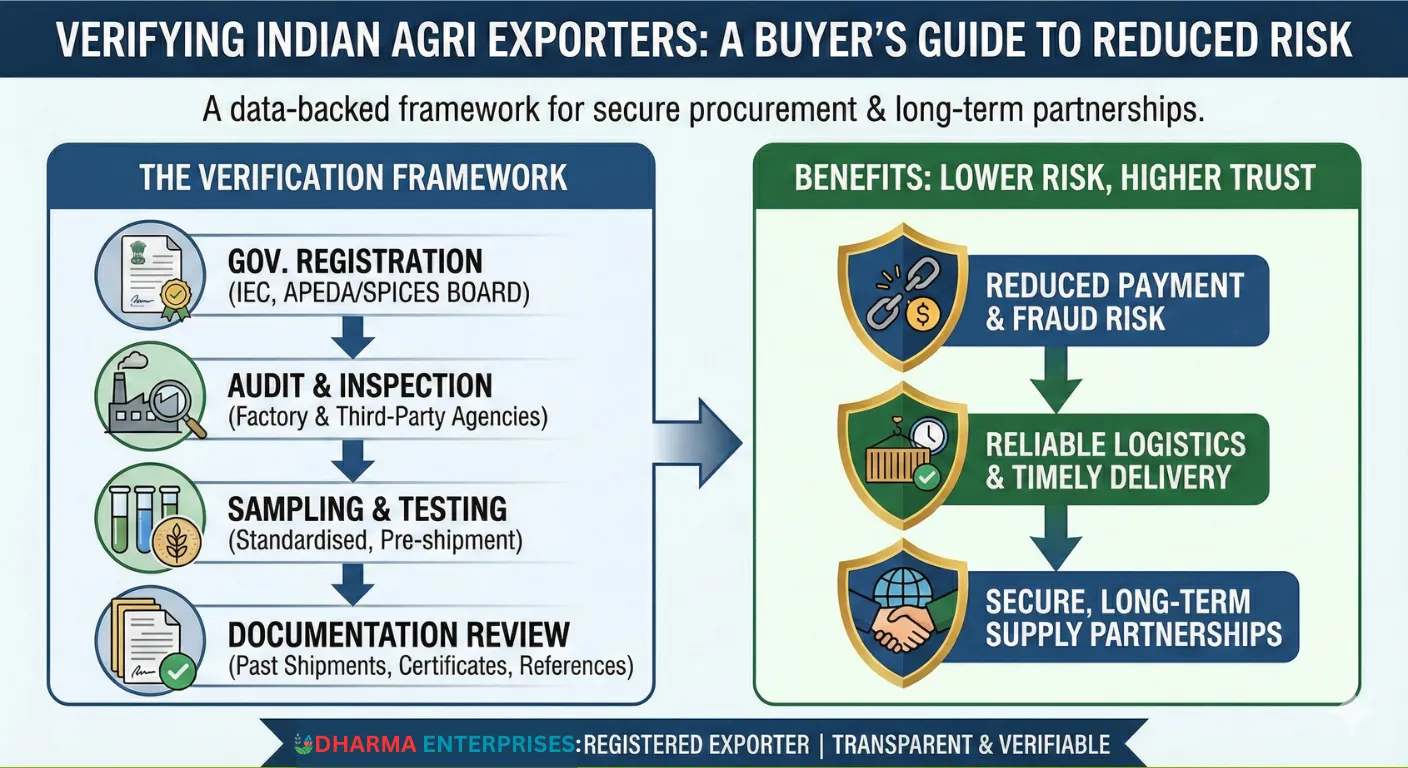
Global agricultural trade has grown fast over the past decade, and India has become one of the world’s most reliable suppliers of rice, spices, pulses, fruits, and processed agri commodities. India’s Ministry of Commerce reports that agricultural and processed food exports have exceeded USD 50 billion a year in recent years, underlining the country’s place in global food supply chains (Ministry of Commerce & Industry, 2024, Agricultural Export Performance Report). With that growth, though, comes supplier risk. International buyers—especially first-time importers—often run into quality mismatches, payment fraud, and logistics delays when they work with unverified exporters. This guide gives you a clear, data-backed way to verify Indian agricultural exporters, reduce procurement risk, and build lasting, reliable supply partnerships.
Risks of choosing unverified suppliers
Shipment quality mismatch
One of the most common problems in international agricultural sourcing is receiving goods that don’t match what you contracted. Quality mismatches often show up as:
- Wrong grading or size specs
- Higher moisture leading to spoilage
- Excess foreign matter or contamination
- Failure to meet pesticide residue limits
The European Commission’s Rapid Alert System for Food and Feed (RASFF) still reports many alerts each year linked to pesticide residues and contamination in imported agricultural goods—a reminder of how important strict supplier verification is (European Commission, 2024, RASFF Annual Report). When quality fails, you can end up with rejected shipments, destroyed cargo, or fire-sale resale, and the financial hit is real.
Payment fraud
Payment-related fraud stays a major concern in cross-border agri trade. Risks include suppliers vanishing after an advance payment, fake firms posing as real exporters, and manipulated documents or shipment proof. The International Chamber of Commerce notes that agricultural commodities are among the sectors most exposed to cross-border trade fraud because of fragmented supplier networks and different verification practices (ICC, 2023, Global Trade Fraud Risk Analysis).
Shipment delays
Agri shipments are time-sensitive: products can be perishable, and demand is often seasonal. Unverified exporters may lack proper logistics, leading to missed deadlines, wrong documentation and port clearance delays, or poor container handling and cargo damage. The International Trade Centre points to logistics inefficiencies as one of the main causes of agricultural trade disputes worldwide (ITC, 2023, Trade Logistics and Export Risk Report).
Government export registration and verification
India has put in place regulatory systems to support exporter legitimacy. Buyers should check suppliers through official government registration channels.
Import Export Code (IEC) verification
The Import Export Code is a mandatory licence issued by India’s Directorate General of Foreign Trade (DGFT). Every legitimate exporter must have an IEC. Buyers can verify by asking for the IEC number and cross-checking it in DGFT databases. The DGFT states that IEC registration is essential for any business engaged in international trade from India (DGFT, 2024, Export Registration Guidelines).
Export promotion council memberships
India has several commodity-specific export councils under government oversight. Membership signals industry credibility and compliance. Major councils include the Agricultural and Processed Food Products Export Development Authority (APEDA), Spices Board India, Tea Board India, and Coffee Board India. They promote quality standards, market intelligence, and exporter certification. APEDA confirms that exporters registered under its framework must meet compliance and documentation requirements before conducting international agricultural trade (APEDA, 2024, Export Registration Standards).

Factory and farm audit best practices
Physical and operational audits add a deeper layer of verification beyond registration alone.
Physical audits
Buyers should carry out factory or processing-unit audits to check processing capacity, hygiene and sanitation, quality control setup, and storage and packaging. On-site audits help confirm whether the exporter can deliver the volumes and quality you’ve agreed. The Food and Agriculture Organization emphasises that physical audits significantly cut supplier compliance risk in agricultural sourcing (FAO, 2023, Supplier Verification and Audit Framework).
Third-party inspection agencies
Many buyers use internationally recognised inspection agencies for neutral supplier audits. These agencies assess product quality, facility compliance, shipment readiness, and packaging and labelling accuracy. Common names include SGS, Bureau Veritas, and Intertek. They provide verification that global importers widely accept.
Shipment sample testing before bulk purchase
Sampling is one of the most effective ways to reduce risk in agri trade.
Sampling standards
Professional exporters follow standardised sampling methods that represent the whole lot. Sampling lets you evaluate grading, moisture, residue compliance, and appearance and sensory attributes. The Codex Alimentarius Commission recommends standardised sampling techniques for consistent quality evaluation (Codex Alimentarius Commission, 2023, Sampling Guidelines for Agricultural Commodities).
Retention sample policies
Reliable exporters keep retention samples for each shipment, stored and documented for dispute resolution. Those samples allow quality verification if something goes wrong, traceability across batches, and legal protection for both sides. Best practice is to store retention samples until product shelf life has expired.
Trade documentation buyers should always request
Proper documentation is essential for verification and regulatory compliance.
Past shipment records
Ask for historical shipment records: bill of lading copies, export invoices, and destination-country records. Past shipment data shows the exporter’s experience and operational capacity.
Inspection reports
Inspection reports show that products meet contract and regulatory requirements. They typically include grading results, residue test results, packaging verification, and loading supervision. APEDA’s export compliance guidelines stress inspection certification as a key requirement for agricultural export credibility (APEDA, 2024, Agricultural Export Documentation Standards).
Customer references
References from other international buyers give useful insight into reliability. Check shipment consistency, transparency in communication, and how disputes are handled. The International Trade Centre highlights reference verification as one of the most effective buyer risk-assessment tools in global trade (ITC, 2023, Supplier Due Diligence Handbook).
Additional verification strategies to consider
Quality certification review
Verify supplier certifications such as ISO 22000, HACCP, GlobalG.A.P., and organic certifications where relevant. These show that the exporter has structured quality and food safety systems in place.
Digital trade presence verification
Legitimate exporters usually have an official company website, verified export registrations, clear product specifications, and documented supply chain information. Cross-checking this information across several platforms helps reduce fraud risk.
Conclusion
India offers one of the most diversified and reliable agricultural sourcing ecosystems in the world. Success, though, depends heavily on supplier verification and due diligence. Buyers who verify exporters through government registrations, physical audits, third-party inspections, standardised sampling, and documentation review cut trade risk significantly. As global agricultural trade keeps expanding, verification and compliance will stay central to safe, profitable, long-term sourcing. By following structured supplier verification practices, you can confidently tap into India’s agricultural export strengths while keeping procurement uncertainty to a minimum.
Connect with us
We’re a registered exporter with APEDA and Spices Board. Get in touch for IEC details, quotations, and references—we’re happy to share what buyers need to verify and to discuss your shipment.
Get a quote nowSources and further reading: Ministry of Commerce & Industry India (Agricultural Export Performance Report); European Commission RASFF; ICC (Global Trade Fraud Risk Analysis); ITC (Trade Logistics and Export Risk Report, Supplier Due Diligence Handbook); DGFT (Export Registration Guidelines); APEDA (Export Registration Standards, Agricultural Export Documentation Standards); FAO (Supplier Verification and Audit Framework); Codex Alimentarius Commission (Sampling Guidelines for Agricultural Commodities).