
The West African Staple: Why Indian Non-Basmati Rice is the Perfect Match for the African Market (2026 Outlook)
The 13.7% surge in Sub-Saharan rice imports, why IR 64 parboiled fits Jollof and Thieboudienne, and how the numbers stack up for your procurement.
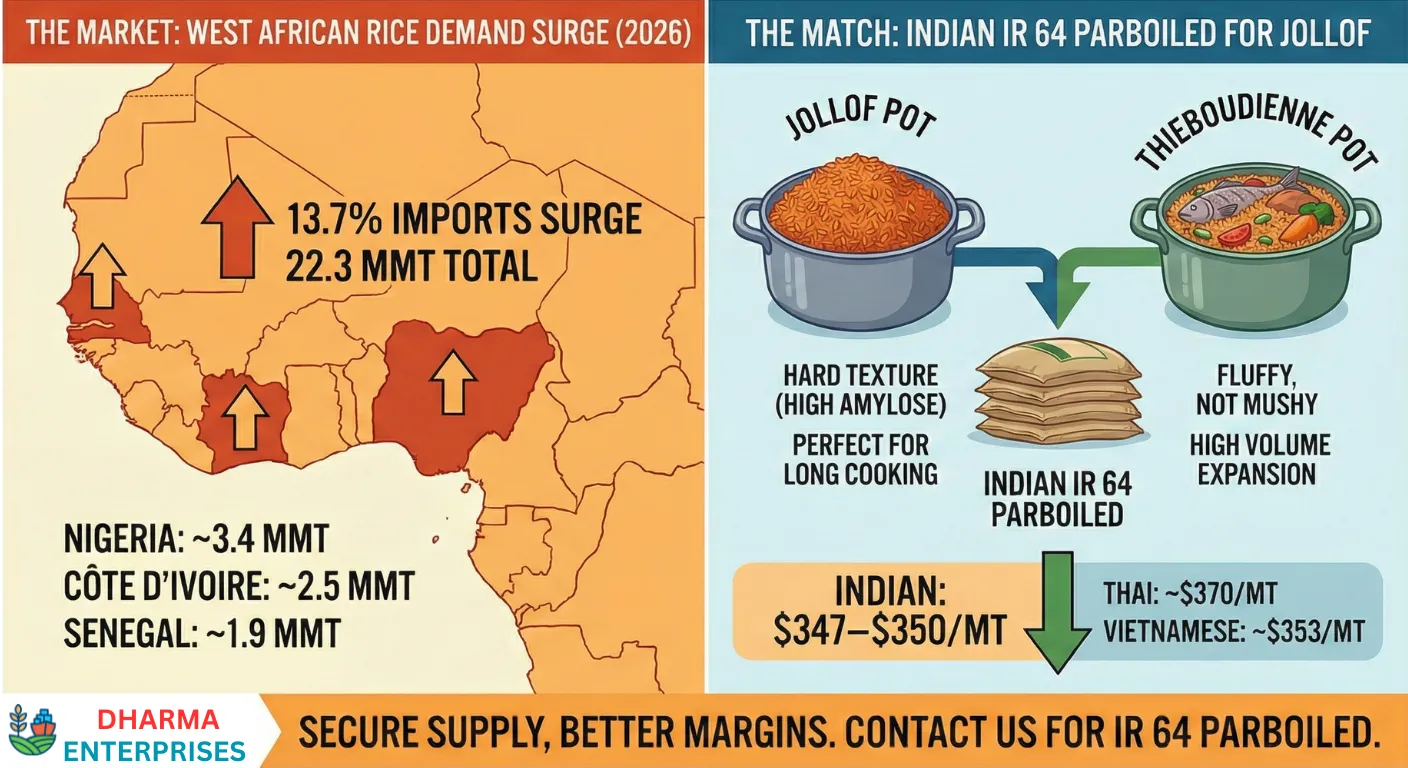
The numbers for the 2025–2026 trading season are in, and they tell a pretty compelling story. According to the latest data from OSIRIZ and S&P Global Platts, rice imports into Sub-Saharan Africa surged by 13.7% in 2025, reaching a staggering 22.3 million metric tons.
If you’re an importer in Nigeria (importing around 3.4 MMT), Côte d'Ivoire (around 2.5 MMT), or Senegal (around 1.9 MMT), that demand spike is a real opportunity—as long as the price point works for you.
Thai and Vietnamese rice have long had the prestige, but in 2026 the picture has shifted. Indian non-basmati varieties, and in particular Parboiled IR 64, are now outperforming the competition not only on price but on what actually matters for West African cooking. Here’s why Indian rice is the smart buy for your Q1/Q2 procurement.
The science of texture – built for Jollof
To most people, rice is just rice. To a West African wholesaler, texture is everything. If the rice turns to mush in a catering pot, you’ve lost that customer.
What gives Indian IR 64 Parboiled the edge is its amylose content and the way parboiling works.
- The “hard texture” advantage: Dishes like Jollof (Nigeria/Ghana) or Thieboudienne (Senegal) are one-pot meals cooked in heavy, tomato-based sauces for a long time. Soft, sticky rice (the kind you see a lot in East Asia) falls apart under that kind of heat.
- What parboiling does: In India, parboiling means a proper hydrothermal process: soaking → steaming → drying before milling.
- Gelatinization: That process gelatinizes the starch inside the husk and effectively hardens the grain.
- Retrogradation: When the grain cools, the starch retrogrades, which makes the grain much firmer.
Result: When your end customer cooks Indian IR 64 Parboiled, the grains swell to about twice the size without breaking (a high volume expansion ratio) and stay separate and firm. That “fluffy but not mushy” texture is exactly what West African palates are looking for.
The logistics advantage – consistency when it matters
In this business, availability often matters as much as quality. Southeast Asian origins can be hit by seasonal swings; India’s export side is running at full capacity.
- Volume you can count on: India is projected to export over 24 million metric tons in the 2025/26 season (up about 5.2% year on year), so supply shortages are the exception rather than the rule. That means large, steady monthly shipments without the “out of stock” surprises you get with smaller origins.
- Routes that are already there: Sailings from India’s east coast (Kakinada, Visakhapatnam) to West African hubs (Apapa, Tin Can, Dakar, Cotonou) are well-established—both break-bulk and container.
- Packaging that travels well: Humidity in Lagos and Abidjan is no joke. At Dharma Enterprises we use 50 kg polypropylene (PP) bags with a high GSM (grams per square meter). They’re breathable but moisture-resistant, so you avoid sweating and spoilage during the long sea leg and in the warehouse.
The economics – better margins, same quality
When you’re moving volume, even $10 per ton can define your year. As of January 2026, the spread clearly favors Indian origin.
- The price gap: Latest FOB assessments tell the story. Thai parboiled is around $370 USD/MT, while Indian parboiled (5% broken) is in the $347–$350 USD/MT range.
- What that means for you: On a typical vessel load of 12,500 MT, a $20/MT saving is $250,000 in extra margin for you—with no drop in quality or cooking performance.
Market snapshot: Q1 2026 comparative analysis
| Feature | Indian IR 64 Parboiled | Thai Parboiled (Standard) | Vietnamese Parboiled |
|---|---|---|---|
| Est. FOB Price (Jan ’26) | $347 – $350 / MT | ~$370 / MT | ~$353 / MT |
| Texture profile | Hard / fluffy (high amylose) | Medium / soft | Medium |
| Cooking endurance | Excellent (high stability) | Moderate | Moderate |
| Volume expansion | High | Medium–high | Medium |
| Primary use case | Jollof / catering / bulk | Household / premium | General |
Data source: aggregated from S&P Global Platts & OSIRIZ market reports (Jan 2026).
Secure your supply for the season
The data from 2025 makes one thing clear: West African demand is growing, and Indian rice is one of the most efficient ways to meet it. When you choose Indian IR 64 Parboiled, you’re not just buying a commodity; you’re getting a product that is:
- A natural fit for local cuisine (high amylose, hard texture).
- Logistically reliable thanks to India’s large export surplus.
- Better on the bottom line, with stronger margins per metric ton.
Better to lock in before the season gets ahead of you.
Next step: Want to make the most of your margins this quarter? Get in touch with Dharma Enterprises for a tailored quote on IR 64 Parboiled Rice. We offer transparent contracts, strictly graded quality (Sortex cleaned), and shipping options that suit West African ports.
Ready for a bespoke quote on IR 64 Parboiled?
We work with importers who care about quality, compliance, and reliable delivery to Apapa, Dakar, Cotonou, and beyond.
Get a quote nowReferences for verification:
- OSIRIZ (Observatoire de la Statistique Internationale du Riz) – Jan 2026 report on Sub-Saharan import volumes.
- S&P Global Platts – Jan 12, 2026 price assessments (FOB India vs. Thailand).
- USDA Foreign Agricultural Service – 2025/2026 Rice Outlook & Export Projections.